
Fertility 101 · Free tool
Is your progesterone–estrogen balance off?
Hormone issues rarely arise from a single value. Often the problem isn’t the hormones themselves but their balance. The Pg/E2 ratio shows whether there’s enough progesterone to counter estradiol. Enter your values below to calculate it.
By Serhii Zatsarynin · Published December 1, 2025
Progesterone: nanograms per milliliter (ng/mL), nanomoles per liter (nmol/L).
Estradiol: picograms per milliliter (pg/mL), picomoles per liter (pmol/L).
Conversions: 1 ng/mL ≈ 3.18 nmol/L · 1 pg/mL ≈ 3.671 pmol/L. Changing a unit automatically converts the value you entered.
Note: This tool is for informational purposes only and does not replace professional medical interpretation.
What Is the Progesterone to Estrogen Ratio?
The Progesterone to Estrogen Ratio (Pg/E2) compares the concentration of progesterone (Pg) to estradiol (E2), the most biologically active form of estrogen.
Why estradiol? The body produces several estrogens (estradiol, estrone, estriol), but estradiol is the dominant and most potent estrogen in cycling women. It is therefore the primary estrogen used in clinical assessment of hormonal balance.
Purpose of the Pg/E2 Ratio
The Pg/E2 ratio helps explain how progesterone and estradiol work together across the cycle. Estradiol helps build and thicken the uterine lining. Progesterone helps stabilize and mature that lining after ovulation. In simple terms, estrogen prepares the tissue, while progesterone helps organize and calm the response.
When progesterone is too low compared with estradiol, estrogen may have a stronger effect, even if estradiol itself appears “normal.” This pattern is often discussed as estrogen dominance, meaning estrogen activity is not being properly balanced by progesterone.
When Should the Pg/E2 Ratio Be Measured?
For cycling women, the ratio is meaningful only if measured at the mid-luteal phase, typically:
- 5–7 days after ovulation,
- around day 19–22 of a 28-day cycle.
Testing too early can be misleading. In the follicular phase, estrogen is naturally more active and progesterone is naturally low. That can create a low Pg/E2 ratio that is completely normal for that part of the cycle. For postmenopausal women, both estrogen and progesterone are naturally lower; the ratio can still be calculated, but it is interpreted differently, especially when hormone therapy is involved.
Progesterone to Estrogen Formula
To calculate the Pg/E2 ratio, both hormone concentrations must be in the same units. This is the step where most errors occur.
Pg/E2 ratio = Progesterone (Pg) ÷ Estradiol (E2) (after unit conversion)
Example: Progesterone 20,000 pg/mL ÷ Estradiol 100 pg/mL = a Pg/E2 ratio of 200.
Progesterone to Estrogen Normal Value
When measured in the mid-luteal phase in healthy, cycling women, typical ranges are:
- Progesterone (P, Pg): 11 to 29 ng/mL, or about 35 to 95 nmol/L.
- Estradiol (E2): 19 to 160 pg/mL, or about 70 to 600 pmol/L.
After unit conversion, an often-cited optimal Pg/E2 ratio for healthy women during the luteal phase is 100 to 500. This means progesterone is 100 to 500 times higher than estradiol when both are measured in pg/mL, as long as estradiol itself is within the normal luteal range.
How This Ratio Is Used Clinically
- 100–500 → suggests an adequate progesterone “buffer” against estradiol’s effects.
- <100 → suggests estrogen dominance (relative progesterone deficiency).
- >500 → suggests progesterone dominance, often in the context of supplementation.
Estrogen Dominance
Estrogen dominance describes a state where estrogen’s actions are inadequately balanced by progesterone. In Pg/E2 terms, this often appears as Pg/E2 < 100. Estradiol may be normal or even low in absolute terms; the imbalance arises because progesterone is too low relative to estradiol, particularly in the luteal phase.
Common causes include anovulatory cycles (no ovulation → no corpus luteum → low progesterone), perimenopause (progesterone declines earlier and more sharply than estrogen), chronic stress (favoring cortisol over progesterone synthesis), obesity (adipose tissue converts androgens to estrogen via aromatase), and liver overload, gut dysbiosis, or exposure to xenoestrogens (BPA, phthalates, etc.).
Common symptoms of estrogen dominance (low Pg/E2): heavy or prolonged menstrual bleeding; more intense PMS or PMDD; uterine fibroids, endometriosis, tender or fibrocystic breasts; weight gain (hips, thighs, abdomen); water retention and bloating; headaches or menstrual migraines; anxiety, irritability, mood swings, “brain fog”; low libido, fatigue, poor sleep.
Progesterone Dominance
Progesterone dominance means progesterone is disproportionately high relative to estradiol, often reflected as Pg/E2 > 500. This pattern is relatively uncommon compared with estrogen dominance and is often iatrogenic — caused by high-dose progesterone or pregnenolone supplementation, rather than natural physiology (with the exception of pregnancy).
Common symptoms of progesterone dominance (high Pg/E2): fatigue, sedation, daytime sleepiness; bloating, slower digestion; low mood or emotional flattening; low libido; and in some cases signs of relative estrogen deficiency (e.g., vaginal dryness, hot flashes), especially if estrogen is already low.
Long-Term Consequences of Chronic Imbalance
Chronic unopposed estrogen (low Pg/E2 for long periods) may contribute to endometrial hyperplasia, a higher risk of certain hormone-sensitive cancers (endometrial, some breast cancers), progression of fibroids and endometriosis, and increased risk of recurrent miscarriage or implantation failure. Persistently distorted ratios can also negatively affect quality of life: pain, sleep issues, mood disorders, and sexual dysfunction.
Ratio questions, answered
Frequently asked questions
Disclaimer
The information in this article and any associated calculator is for informational and educational purposes only. It is not a substitute for professional medical advice, diagnosis, or treatment. Never ignore or delay seeking professional medical advice because of something you have read here. Always consult your doctor, gynecologist, endocrinologist, or other qualified healthcare provider for personalized evaluation and treatment.
References
- Serum estradiol/progesterone ratio on day of embryo transfer may predict reproductive outcome following controlled ovarian hyperstimulation and IVF — PMC
- Evidence for a local change in the progesterone/estrogen ratio in human parturition at term — PubMed
- Increased progesterone/estradiol ratio in the late follicular phase could be related to low ovarian reserve in IVF-embryo transfer cycles — PubMed
- Progesterone — Wikipedia
- Estrogen — Wikipedia
- Estrogen Dominance — Whole Health Library
- Endocrine Disruptors — National Institute of Environmental Health Sciences
- Hormones in Beef: Myths vs. Facts
See estrogen fits into the balance
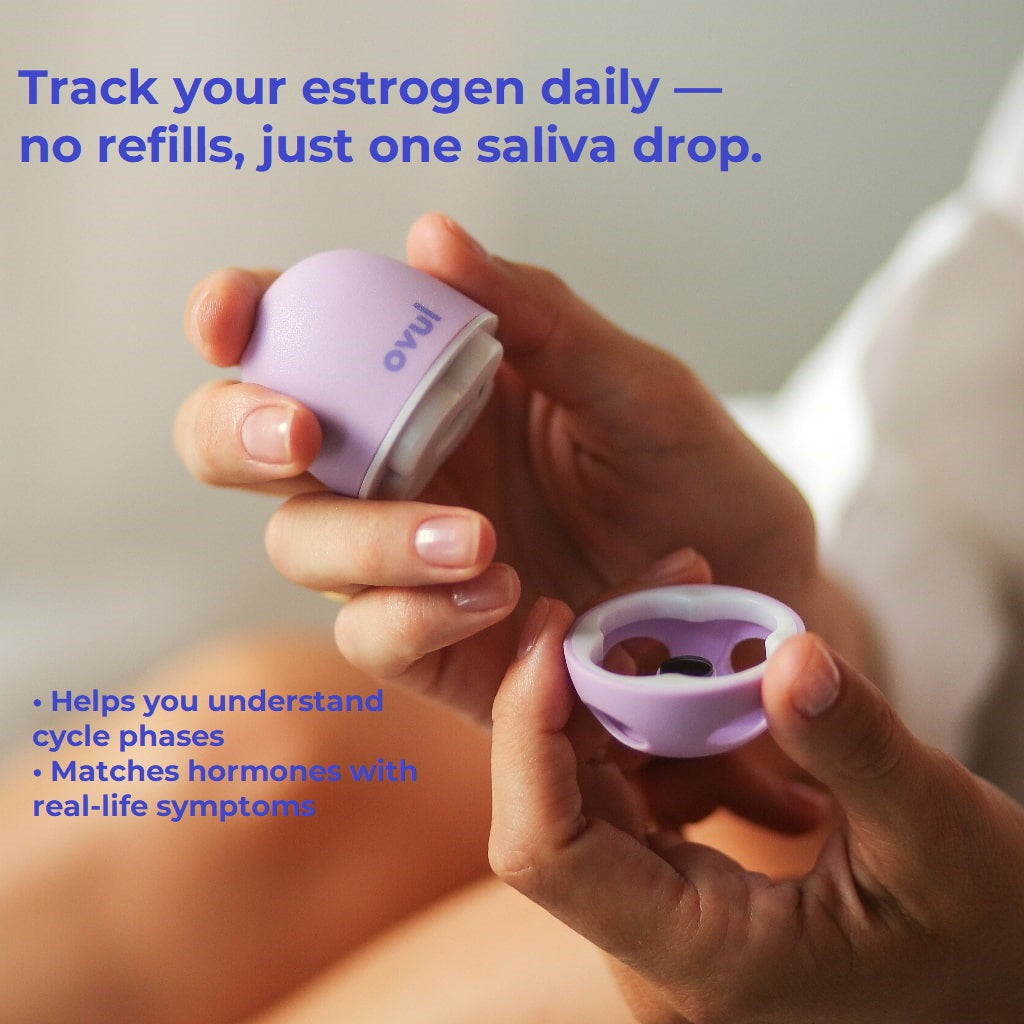
Track your estrogen trend before your next blood test
Ovul focuses on estrogen-induced patterns through saliva-based ferning analysis and AI. Follow your estrogen trend over time to add context to cycle symptoms, ovulation timing, and clinical testing when needed.